
Freedom—With Fine Print: How the Thirteenth Amendment Left a Door Open to Forced Labor
By Diana Smith
“Neither slavery nor involuntary servitude, except as a punishment for crime whereof the party shall have been duly convicted, shall exist in the United States, or any place subject to their jurisdiction.”[1] Marked by the end of the Civil War, on January 31, 1865, Congress passed the Thirteenth Amendment to the Constitution.[2] The Thirteenth Amendment proclaims the abolition of slavery. However, embedded within the language, a loophole exists. Enshrined in the exception clause, a modern form of slavery continues to exist.[3] Slavery is defined as “the practice of keeping individuals in such a state of bondage or servitude.”[4]
Since this amendment, prisoners have been subjected to involuntary servitude. A prisoner can be forced to work or withstand punishment like solitary confinement or even physical beatings.[5] At least six Circuit Courts have held “the presence of forced labor is viewed as a reality of imprisonment and not an unconstitutional punishment.”[6] However, many unknowns still exist with respect to the Thirteenth Amendment’s applicability. For example, is the Amendment meant to encompass forced unpaid labor, or can it also encompass a prisoner who is paid an egregiously low wage?[7] In 2017, the average prison wage in all 50 states ranged from 33 cents per hour to $1.41, whereas the federal minimum wage is $7.25 per hour.[8] Despite the Fifth Circuit diverging from the majority of circuits, the Court held in Watson that a “prisoner who is not sentenced to hard labor retains his Thirteenth Amendment rights.”[9] Ultimately the petitioner in Watson lost because they were paid for their labor. [10]
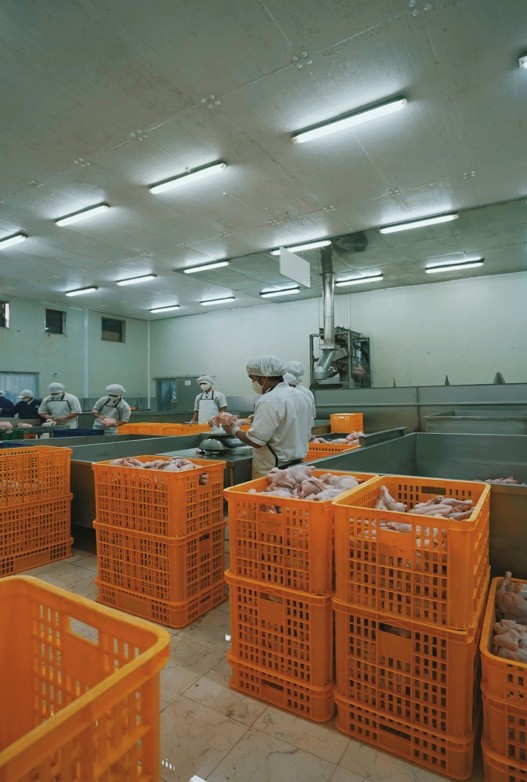
In addition to low wages, inmates also suffer from very few job protections. Incarcerated workers aren’t covered by basic protections such as worker’s compensation or federal safety standards.[11] The lack of safety standards have resulted in death. For example, Frank Dwayne Ellington was sentenced to life in prison for stealing a wallet at gunpoint—a result of Alabama’s Habitual Offenders Act. In 2017, Ellington, “was cleaning a machine near the chicken ‘kill line’…at Koch Foods…when the whirling teeth caught his arm and sucked him inside, crushing his skull.”[12] Frank Ellington died instantly. Koch Foods argued that Ellington wasn’t an employee.[13] The case eventually settled, but Koch Foods was fined because workers had not been given proper training.[14] Despite all this, prison labor continues to seep into the supply chain both in the United States and internationally.[15]
Affecting change will require taking a unique path. Repealing the exception clause in the Thirteenth Amendment can take years and remains pending on the federal level since 2023.[16] More recently several states have amended their constitutions curtailing the use of prison labor.[17] In 2022, Alabama, Oregon, Tennessee, and Vermont all approved ballot measures that could restrain the use of prison labor.[18] Vermonters overwhelmingly approved a state constitutional change (“Proposal 2”) banning slavery and indentured servitude in November 2022.[19] At least a dozen more states have language in their constitution that still permits slavery and involuntary servitude for prisoners, while several other states still have no language permitting or denying forced prison labor.[20] Lawmakers have raised questions about if these amendments will address inmates being paid below minimum wage for their work or only address forced labor. The Vermont Department of Corrections will continue to employ incarcerated workers for pay because Proposal 2 only concerns forced labor. [21]
While abolition of slavery in state constitutions is a necessary first step for eradicating forced labor, additional legislation on the state and federal levels that address specific issues surrounding inmate wages, employee protections, and safety training is imperative. Additional legislative measures may also arise as we address issues such as exploitation of workers in large companies, policies surrounding employment for inmate’s post release, drug policies, and public health policies.
[1] U.S. Const. amend. XIII, § 1 (emphasis added).
[2] 13th Amendment to the U.S. Constitution: Abolition of Slavery, Nat’l Archives (last accessed Sept. 21, 2025), https://www.archives.gov/historical-docs/13th-amendment.
[3] See Terry Tang, Lawmakers mark Juneteenth by reviving ‘abolition amendment’, AP News (June 18, 2021, 2:27 PM), https://apnews.com/article/or-state-wire-race-and-ethnicity-lifestyle-juneteenth-963c58a1a19ba501f5677343b9c786e0.
[4] Slavery, Black’s Law Dictionary (6th ed. 1990).
[5] Megan Massie, Locked Up and Trafficked Out: Prison Labor and the Thirteenth Amendment, 19 U. St. Thomas L. J. 498, 502 (2023).
[6] Wafa Junaid, Forced Prison Labor: Punishment for A Crime?, 116 Nw. U. L. Rev. 1099, 1123 (2022).
[7] Id.
[8] Wendy Sawyer, How much do incarcerated people earn in each state?, Prison Policy Initiative (Apr. 10, 2017), https://www.prisonpolicy.org/blog/2017/04/10/wages/; 28 U.S.C. § 206 (2025).
[9] Junaid, supra note 6, at 1123 (quoting Watson v. Graves 909 F.2d 1549, 1152 (5th Cir. 1990)).
[10] Id.
[11] Robin McDowell & Margie Mason, Prisoners in the U.S. are part of a hidden workforce linked to hundreds of popular food brands, AP News (Jan. 29, 2024, 8:03 AM), https://apnews.com/article/prison-to-plate-inmate-labor-investigation-c6f0eb4747963283316e494eadf08c4e.
[12] Id.
[13] Id.
[14] Id.
[15] Id.
[16] S.J. Res. 33, 118th Cong. (2023).
[17] Aaron Morrison, Slavery, involuntary servitude rejected by 4 states’ voters, AP News (Nov. 9, 2022, 6:17 PM), https://apnews.com/article/2022-midterm-elections-slavery-on-ballot-561268e344f17d8562939cde301d2cbf.
[18] Id. (explaining that Utah, Colorado, and Nebraska have also outlawed slavery in their state constitutions in the last five years.)
[19] Auditi Guha, Vermont voters pass constitutional amendment explicitly prohibiting slavery, vtdigger (Nov. 8, 2022, 10:31P.M.), https://vtdigger.org/2022/11/08/vermont-voters-remove-slavery-references-from-the-states-constitution/.
[20] Morrison, supra note 17.
[21] Sara Mearhoff, Would Vermont’s anti-slavery amendment impact prison labor? Advocates say rhetoric ‘misses the point.’, Human Trafficking Search (2022), https://humantraffickingsearch.org/resource/would-vermonts-anti-slavery-amendment-impact-prison-labor-advocates-say-rhetoric-misses-the-point/.