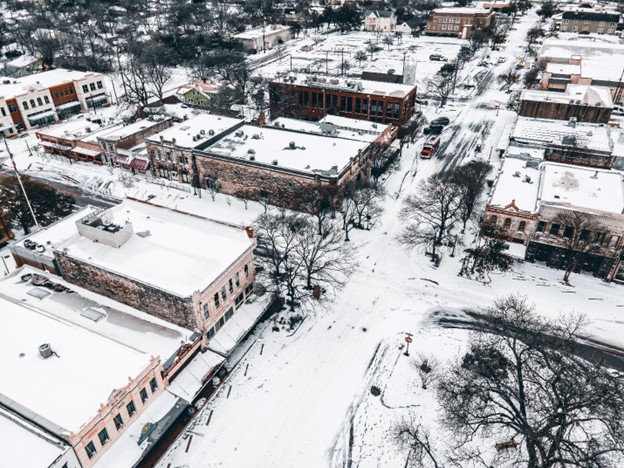
It is February, in Texas, and the lights are out. Texans are weathering an unanticipated cold front. As masses flock indoors, the demand for electricity in the form of light and heat spikes. Meanwhile, several electric generating plants are offline due to complications with the colder-than-expected weather. What year is it?
While most remember the viral Texas blackouts caused by winter storm Uri in 2021, less are aware that Texas has experienced a pattern of severe cold-weather events disrupting its electric service dating back to 1983.[1] Winter storm Uri, undoubtedly, was the biggest of those events: at its peak, the storm took 34,000 MW of electric generation capacity offline, leaving two-thirds of Texans literally powerless.[2] After each of the three most severe cold-weather events in the last 50 years—1989, 2011, and 2021—regulatory bodies conducted investigations and made recommendations “aimed at improving winterization on the part of the [electric] generators.”[3] The recommendations in the 1989 and 2011 reports went largely unheeded by Texan electric generators and regulators, and the 2021 recommendations may meet the same fate.
Officials in Texas are facing increased calls for Texas to connect with the national grid.[4] Texans are finalizing criticizing the State’s repeated failures. The 2011 power outages in Texas were a direct reflection that Texan electric generators lack adequate infrastructure to provide reliable power during cold-weather emergencies. After failing to address these infrastructure concerns in 2011, the Texas Legislature passed two bills in response to Uri: 2021 Senate Bills 2 and 3.[5]
As a law pertaining primarily to state-agency governance, SB 2 did little to improve, or mandate improvements to, Texas’ electric generation infrastructure.[6] Several sections of the bill amended the Texas Utilities Code to require several leadership positions in the Public Utility Commission of Texas to be Texas residents, providing little (if any) support to Texas’ grid infrastructure.[7] While having a resident of the state in charge of regulating public utilities may provide a better leader, this requirement in no way guarantees better leadership or any meaningful action to protect Texas’ grid. Likely, the Texas Legislature put this provision in place to increase the likelihood of Texas remaining independent from federal regulation in the face of increasing calls for Texas to join the national grid.[8] Overall, SB 2 does little to curb Texas’ power issues and instead provides for Texas continuing energy independence by mandating protectionist laws, which put all positions of power in Texas’ energy regulatory scheme in the hands of Texans.
While SB 2 involved small amendments to existing code with some new sections, the lengthier SB 3 established several new sections of code. The bill created two new committees for developing and enforcing reliability standards; established new emergency response alert systems; and raised the fines chargeable to noncompliant utilities. Ultimately, the bill is likely to enhance confusion around who is responsible for energy reliability in Texas. The federally delegated Texas Reliability Entity, the Public Utilities Commission of Texas (PUCT), the Texas Railroad Commission, and now both the Texas Energy Reliability Council and Texas Electricity Supply Chain Security and Mapping Committee all have some statutory duties around the development and enforcement of reliability standards for energy producers and transmission operators in the state of Texas.[9]
Texas has a major energy infrastructure problem that the state has failed to address for decades. As climate change ramps up, the occurrence of severe weather events in Texas (and elsewhere) is highly likely to increase. The most recent cold-weather blackouts of 2021 were the most severe on record, resulting in a number of fatalities and a huge economic hit to the state. If Texas does not address the shortcomings of its electric generation infrastructure, it is doomed to continue suffering from worse and worse blackouts like those in February 2021.
The current response, 2021 SB 2 and SB 3 signed into law in the wake of Uri, is not enough. The two bills together primarily increase reporting functions of the PUCT and other energy-related entities. By assigning many organizations the job of creating, proposing, and enforcing new and improved reliability standards for Texas’ infrastructure, the Texas Legislature is asking for confusion and dysfunction as competing federal and state agencies fight over reliability standards. More importantly, each of those entities will be left pointing the finger at the other in the wake of the next cold-weather blackouts.
Now to get back to where we started: it is February, in Texas, and the lights are out. Texans are weathering an unanticipated cold front. As masses flock indoors, the demand for electricity in the form of light and heat spikes. Meanwhile, several electric generating plants are offline due to complications with the colder-than-expected weather. What year is it? Hopefully not 2023, 2024, or beyond.
[1] Fed. Energy Reg. Comm’n and N. Am. Elec. Reliability Corp., Report on Outages and Curtailments During the Southwest Cold Weather Event of February 1–5, 2011: Causes and Recommendations 7 (2011) [hereinafter FERC/NERC 2011 Report].
[2] Umair Irfan, Why the Texas Power Grid is Struggling to Cope with the Extreme Cold, Vox (Feb. 16, 2021), https://www.vox.com/2021/2/16/22284140/texas-blackout-outage-winter-storm-uri-ercot-power-grid-cold-snow-austin-houston-dallas.
[3]FERC/NERC 2011 Report at 10; Fed. Energy Reg. Comm’n and N. Am. Elec. Reliability Corp., The February 2021 Cold Weather Outages in Texas and the South central United States 8 (2021) [hereinafter FERC/NERC 2021 Report].
[4]See, e.g., Erin Douglas et al., Texas Leaders Failed to Heed Warnings the Left the State’s Power Grid Vulnerable to Winter Extremes, Experts Say, Tex. Trib. (Feb. 17, 2021), https://www.texastribune.org/2021/02/17/texas-power-grid-failures/ (stating that “Texas policy makers should consider more connections to the rest of the country.”); see, e.g., Catherine Morehouse, Congress, Texas Should ‘Rethink’ ERCOT’s ‘Go it Alone Approach’: FERC Chair Glick, Util. Dive (Feb. 19, 2021), https://www.utilitydive.com/news/congress-texas-should-rethink-ercots-go-it-alone-approach-ferc-chair/595335/ (quoting then-FERC Chairmain Richard Glick, who called Texas energy independence “just to keep FERC at bay . . . as the proverbial cutting off your nost to spite your face.”).
[5] 2021 Tex. Gen. Laws 425 (SB 2); 2021 Tex. Gen. Laws 418 (SB 3).
[6] Recall from both the 2011 and 2021 FERC/NERC reports that poor infrastructure—not poor oversight—was the main culprit of the outages. While oversight and infrastructure development are related, the PUCT had the ability to mandate infrastructure improvements prior to SB 2’s passage. See FERC/NERC 2011 Report; see FERC/NERC 2021 Report.
[9]See 16 U.S.C. § 824 (delegating authority over reliability standards to NERC, and further commanding regulators to allow NERC to delegate further—which it has done in many cases, including to the Texas Reliability Entity, one of many governing bodies with authority over reliability standards in Texas.); see also Tex. Util. Code § 39.151 (delegating the Public Utilities Commission of Texas to “adopt and enforce rules relating to reliability of the regional electrical network.”); see also Tex. Util. Code § 121.2015 (assigning the Texas Railroad Commission the responsibility of adopting rules for gas pipeline service reliability); see also 2021 Tex. Gen. Laws. 418 (creating the Texas Energy Reliability Council and the Texas Electricity Supply Chain Security and Mapping Committee; both entities have reliability related responsibilities outlined in the code).
Our failure to properly account for the use of our ocean and our ocean’s resources has increased the presence of illegal ocean activities. Overfishing, as a response to the overwhelming demand for inexpensive seafood, has forced fishers to travel far and wide to find viable fish stocks or board illegal fishing vessels for hardly any pay. Human trafficking on fishing vessels in international waters is a global tragedy that desperately needs attention. The lack of regulation and enforcement in international waters creates a culture and environment on large capture boats that can be hostile and life threatening. The Trafficking in Persons Report (TIP) is an annual report published by the United States Department of State that includes an analysis of human trafficking in every country, promising practices to combat trafficking, victim’s stories, and current trends.[1] The TIP identified Burma, Haiti, Thailand, Taiwan, Cambodia, Indonesia, South Korea, and China as countries dealing with trafficking and forced labor in the fisheries sector.[2] Forced labor on international fishing vessels occurs worldwide, affecting the lives of thousands of people.
Humans are exploited to work in severely unethical, dangerous, and uninhabitable conditions on fishing vessels. Forced labor encompasses many different activities including recruiting, harboring, obtaining, transporting, and providing when combined with the use of force or physical threats; psychological coercion; abuse of the legal process; a scheme, plan, or pattern intended to hold a person in fear of serious harm; or other coercive means to compel someone to work.[3] According to the United States Department of Health and Human Services, consequences of labor trafficking can include “helplessness, shame and humiliation, shock, denial and disbelief, disorientation and confusion, and anxiety disorders including posttraumatic stress disorder (PTSD), phobias, panic attacks, and depression.”[4] The victims are often “unfamiliar with the laws, cultures, and languages of the countries in which they have been trafficked because they are often subjected to coercion and intimidation including physical detention and debt bondage,” and they hesitate to report the crimes perpetrated against them because they “often fear retribution and forcible removal to countries in which they will face retribution or other hardship.”[5] To combat this issue, the congressionally enacted Forced Labor statute provides the best route for success.
The Trafficking Victims Protection Act (TVPA) of 2000 established human trafficking crimes, including forced labor and sex trafficking, in the United States.[6] Under the TVPA, the U.S. government has broad extraterritorial power to prosecute crimes including forced labor on any U.S. (or foreign) vessel operating in international waters.[7] However, a gap lies between the jurisdictional bounds of 18 U.S.C. § 1589, the Forced Labor statute, and Special Maritime Territorial Jurisdiction (SMTJ). Currently, 18 U.S.C. § 1589 does not fully extend to the SMTJ of the United States, whereas sex trafficking does under 18 U.S.C. § 1591.[8] Thus, if a person was suspected of human trafficking on a U.S. fishing vessel but is not a U.S. citizen and never enters U.S. territory but enters the SMTJ, that person would be subject to criminal liability for sex trafficking but not for forced labor committed in the SMTJ. The forced labor statute has the potential to create powerful change for human rights violations in international waters. The serious nature of forced labor crimes, as well as the likelihood that forced labor crimes occurring on fishing vessels will be committed in the SMTJ but outside current limits on U.S. jurisdiction over forced labor, warrant legislation that extends SMTJ to address this issue. Congress should extend SMTJ to the crime of forced labor by amending 18 U.S.C. § 1589.
[1] U.S. Dep’t of State of State, Trafficking in Persons Report (2020),
[4] U.S. Dep’t of Health & Hum. Servs., Labor Trafficking Fact Sheet (2012), https://www.acf.hhs.gov/archive/otip/fact-sheet/fact-sheet-labor-trafficking-english.
[5] United States v. Sabhnani, 599 F.3d 215, 253(2d Cir. 2010) (quoting TVPA, Pub. L. No. 106-386, § 102(b)(5), 114 Stat. 1464 (2000)).
[6] Victims of Trafficking and Violence Protection Act of 2000, Pub. L. No. 106–386, 114 Stat. 1464 (2000) (codified at 22 U.S.C. § 7101).
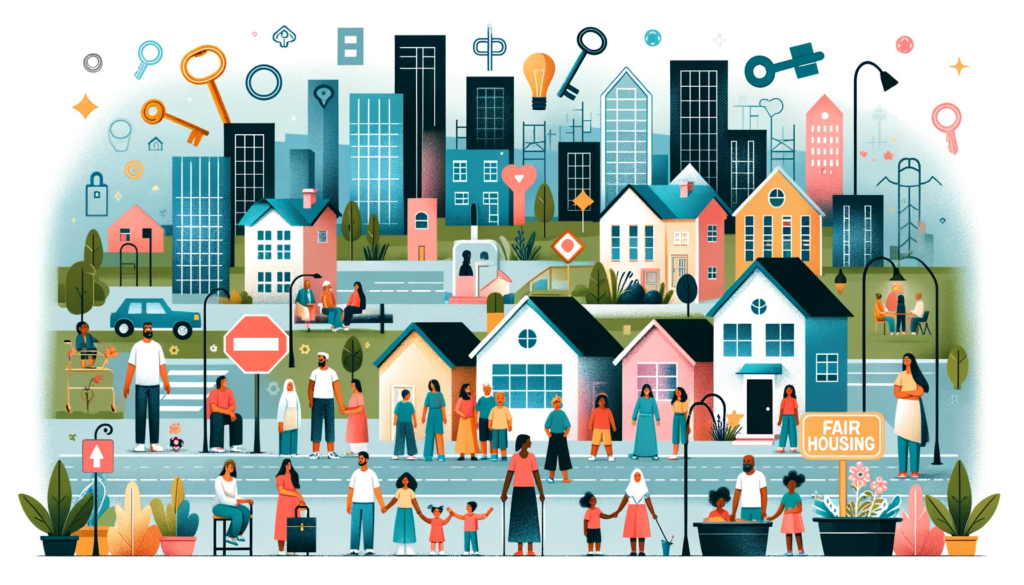
Is housing a fundamental right? What about for mixed status families? Is there a gap in federal law regarding housing rights and protections for mixed status families? How has New York addressed immigration-sensitive housing issues? And can Vermont learn from New York?
These are all questions left unanswered by the current housing legal framework, such as the Fair Housing Act (FHA) and related civil rights laws. Housing exclusions multiply for low-income families that have members who lack immigrant status and depend on public assistance to pay for housing. Even with more housing assistance available, many families remain left out.
What does it mean to be a “mixed status family” in the United States (U.S.)? The term mixed status family refers to “families in which one or more family members are U.S. citizens or lawful permanent residents (green card holders) and some are undocumented without legal immigration status.”[1] This family makeup is more prevalent than ever. Approximately 16.2 million people in the United States live in a mixed status family.[2]
But, mixed status families are often forced to separate because federal law does not guarantee the right to fair housing for this suspect class.[3] FHA bans discrimination on the basis of national origin. But FHA does not ban discrimination on the basis of immigration status. [4] Read the previous sentence again the FHA allows discrimination based on immigration status!
This means that the housing assistance regulations, which create subsidy programs, permit excluding people from assistance programs on the basis of immigration status. Approximately two-thirds of people in mixed status families are already U.S. citizens, and over half of them are children.[5] Therefore, categories such as citizens and lawful permanent residents are eligible to receive some housing assistance.[6] However, if they live in a household with a family member that is an “ineligible” immigrant (that may not be an undocumented immigrant),[7] then the eligibility to subsidized housing forces these families to separate in order to receive housing benefits. Mixed status families are prevented from receiving housing benefits by the very essence of their classification.
New York’s approach addresses many housing issues, even when those challenges account for situations outside of the traditional housing accessibility sphere. To start, one of the biggest challenges for mixed status families is having valid identification. Identification helps with getting housing, holding a job to maintain housing, and applying for government programs for housing assistance. Thus, New York established “IDNYC.”[8] IDNYC is a free, municipal identification card for all New Yorkers from all backgrounds and from all five boroughs.[9] Immigration status does not matter, and anyone that is a New York resident, ten years of age or older, can apply to receive one.[10] IDNYC cardholders receive access to an array of benefits which includes discounts for education, health, housing, and many other institutions.[11] Regarding application necessities, IDNYC is accepted for apartment applications, health insurance, entry into public buildings, for taking the high school equivalency exam in New York City, and by employers.[12] This identification card system resolves many issues for mixed status families because undocumented members can obtain a form of identification that helps in the housing searching and maintaining process.
Another challenge when seeking housing is knowing the resources available. Recently, New York expanded its resources while consolidating the different points of contact to all be within two main programs. New York has the following two programs: (1) The City Family Eviction Prevention Supplement Program and the City Family Exit Plan Supplement Program (collectively, the “CityFHEPS Programs”) and (2) Family Homelessness & Eviction Prevention Supplement (FHEPS). CityFHEPS is a city rental assistance program that can help residents findandkeep affordable housing.[13] FHEPS provides rental payments for tenants in various ways depending on the family and its needs. Landlords receive rent payments directly from the New York City Human Resources Administration.[14] This means that part of the rent will be covered by the FHEPS supplement, and the other part comes from the tenant’s Cash Assistance shelter allowance or from the tenant’s income.[15] Collectively, programs such as CityFHEPS and FHEPS, along with other supplementary resources such as IDNYC, come together to open doors for mixed families in New York.
Unlike New York, Vermont’s approach does not consider factors outside of the rental-landlord sphere. Nor does Vermont consider the different issues families face when living in different parts of the state. Infrastructure, financial, and social barriers link back to housing issues and cause exclusion for mixed status families in Vermont.[16] This leaves mixed status families in a cycle of despair that is close to impossible to break out of. Addressing issues such as housing shortages, lack of access to resources, and establishing strong communities with open communication can improve living conditions for all Vermont residents.
However, Vermont is already on the right track. Vermont is one of the few states to offer a driver privilege card.[17] This driver privilege card provides more privileges than what the IDNYC gives New York City residents. Vermont’s driver’s privilege card is available to any Vermont resident and does not require proof of legal presence or U.S. citizenship.[18] The driver privilege card is a Vermont license, but it is not Real ID compliant.[19] This still opens many doors to mixed status families because as explained, having a state related identifications helps with housing opportunities and programs. More resources like the driver privilege card would greatly expand the benefits allowed for mixed status families in its community, work force, and economy.
In conclusion, federal laws address accessibility issues but leave gaps within how those laws limit benefit-related programs for housing. It is up to state laws to fill the gap and provide more resources to address the specific issues for housing, especially for low-income mixed status families. Then, from the state level, comes city and local change. New York demonstrates a prime example of how to adjust to the issues its residents face. Vermont can move towards that model but on a smaller scale to reflect the structure and environment of the state.
[1]Fact Sheet: Mixed Status Families and COVID-19 Economic Relief, Nat’l Immigr. F. (Aug. 12, 2020), https://immigrationforum.org/article/mixed-status-families-and-covid-19-economic-relief/#:~:text=Mixed%20status%20families%20are%20families%20in%20which%20one,United%20States%20live%20in%20a%20mixed%20status%20family.
[3] Although the Supreme Court has concluded immigration status is not a suspect class, immigration status satisfies the Arlington Heights test for disparate impact and therefore qualifies for strict scrutiny. David P. Weber, Restricting the Freedom of Contract: A Fundamental Prohibition, 16 Yale Hum. Rts. & Dev. L. J. 51, 91 (2012). But see generally Graham v. Richardson 403 U.S 365 (1971) (holding that noncitizens are a prime example of a discrete and insular minority for whom such heightened judicial solicitude is appropriate and the power of a state to apply its laws exclusively to its noncitizen residents as a class is very limited).
[4] The Fair Housing Act, 42 U.S.C. §§ 3601–04 (prohibiting discrimination by direct housing providers, such as landlords and real estate companies based on race or color, religion, sex, national origin, familial status, or disability). Familial status and national origin do not include immigration status or mixed status family status.
[5]NLIHC President and CEO Diane Yentel Statement on HUD Withdrawal of Mixed-Status Rule, Nat’l Low Income Hous. Coal. (Apr. 2, 2021), https://nlihc.org/news/nlihc-president-and-ceo-diane-yentel-statement-hud-withdrawal-mixed-status-rule.
[16] Regin Albin, Housing Barriers for Immigrants and Refugees to Vermont, Vt Hous. Fin. Agency (2020) https://www.vhfa.org/sites/default/files/publications/housing_barriers_for_immigrants_to_vermont_0.pdf.
[17]What is a Driver’s Privilege Card?, Vt Dep’t of Motor Vehicles, https://dmv.vermont.gov/faq/what-is-a-drivers-privilege-card#:~:text=A%20Driver%20Privilege%20Card%20is%20a%20Vermont%20license,require%20proof%20of%20legal%20presence%20or%20US%20citizenship (last visited Dec. 3, 2023).
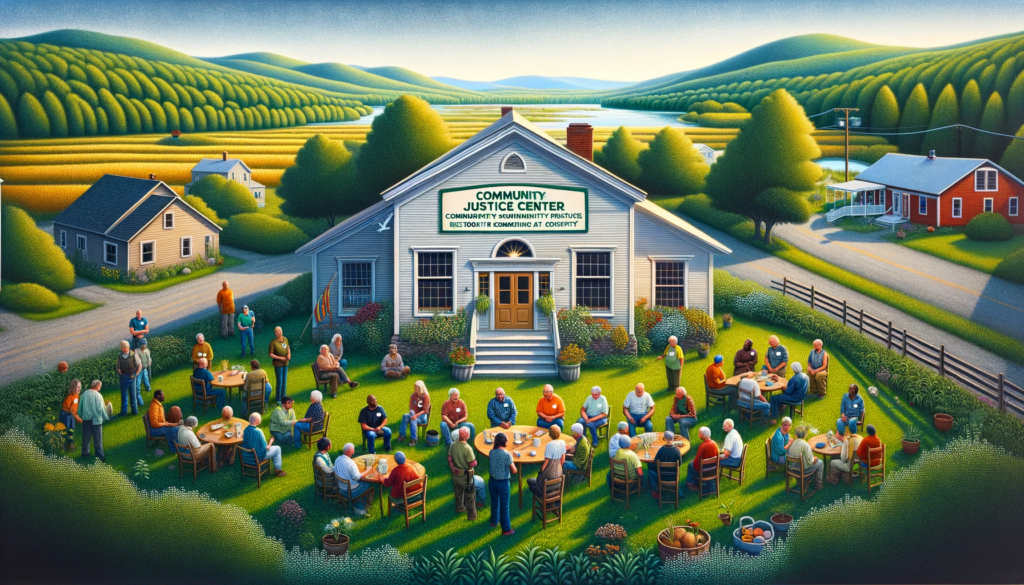
Restorative practices have been adopted and utilized in nearly every state[1], either with legislation or by promoting its use through independent organizations. Vermont has been at the forefront of implementing Restorative practices by codifying them into its state legislation and providing community-based services.[2] Community Justice Centers (Centers) throughout the state provide the essential groundwork for employing Restorative practices to assist the formerly incarcerated population with their re-entry.[3] With help from volunteers, these Centers provide housing, community, and employment support.[4] With a total of 18 centers throughout the state,[5] variations in applying Restorative practices can be problematic. “The decentralized system of delivering alternative justice programs results in inconsistencies in the types and quality of services that are offered in each county.”[6] Notwithstanding these inconsistencies, Vermont has seen success in reducing recidivism.[7]
Despite widespread adoption at the state level, the United States has yet to codify some form of Restorative practice at the federal level. Adopting federal legislation, would allow for more consistency between states, provide guidance on how to implement Restorative alternatives to the traditional adversarial system, and require data collection for important characteristics to better understand how marginalized communities are disproportionately affected.
New Zealand has made some form of Restorative practice available at nearly every stage of its justice system.[8] Focusing on sentencing, New Zealand’s Sentencing Act of 2002[9] (Act) codifies mandatory consideration of Restorative practices during this stage. This Act provides a reasonable and realistic form of federal legislation the United States could implement.
Within the United States, The Mandatory Consideration of Restorative Practices during Sentencing Act would require judges to consider integrating Restorative Practices into prospective sentences for all types of crimes, considering the wishes of those indirectly or directly harmed by the criminal conduct. Because of the great discretion afforded to judges within the legal system, mandatory consideration can easily be combined with current and prospective sentences. This Act does not require the use of Restorative practices. Instead, the purpose and overall goal is to encourage increased reliance on Restorative practices within the legal system.
Requiring judges to consider the victim’s wishes, the steps the defendant took in taking responsibility, and alternatives to punishments—or included in traditional sentences—provides a reasonable and realistic way to initially codify Restorative practices at the federal level within the United States.
[1] Thalia Gonzalez, The Legalization of Restorative Justice: A Fifty-State Empirical Analysis 2019 U. L. Rev. 1030–31(2020). Forty-five states have adopted and codified some form of Restorative practices into law. Id. The five states absent from this list are Arizona, North Carolina, North Dakota, Ohio, and Oklahoma. Id.
[6] Willa Farrell, Pretrial Services and Court Diversion Report pursuant to 13 V.S.A. § 7554c (f) and 3 V.S.A. § 164 (d) 4 (2021).
[7] Jordyn Haime, Restorative Justice Part 3: In Vermont, Restorative Justice Under Statute May Not Lead to Equitable Services, Granite State News Collaborative, https://www.collaborativenh.org/race-and-equity-project-stories/2021/4/20/restorative-justice-part-3-in-vermont-restorative-justice-under-statute-may-not-lead-to-equitable-services (last visited Dec. 3, 2022).
[8] Jim Boyack & Helen Bowen, Adult Restorative Justice in New Zealand/Aotearoa, Int’l Inst. for Restorative Pracs. (Aug. 30, 2003), https://www.iirp.edu/news/adult-restorative-justice-in-new-zealand-aotearoa.
State laws are important tools in a federalist system. They can serve as experiments for more advanced and ambitious policies than those existing at the federal level. This famous sentiment was expressed by Justice Brandeis who stated, “It is one of the happy incidents of the federal system that a single courageous state may . . . serve as a laboratory; and try novel social and economic experiences without risk to the rest of the country.”[1] Today, this sentiment may be used to recognize the ability of states to take initiative on pertinent societal issues instead of waiting for the federal government to act. In a time where there are increasingly pressing environmental issues, the restraints on federal power make the use of state law more important.[2] This may be an important avenue to address novel environmental issues that are not adequately addressed by the National Environmental Policy Act (NEPA), which functions as merely procedural.
Various states have developed their own versions of NEPA.[3] Fifteen states and the District of Columbia have these little-NEPAs,[4] also referred to as State Environmental Policy Acts (SEPAs).[5] Some of these state acts are nearly identical to NEPA, and others share many similarities.[6] While the state jurisprudence oftentimes follows the federal NEPA jurisprudence, some states have diverged further in their case law.[7] In doing so, certain states have enhanced their SEPA requirements.
SEPAs can include substantive requirements with language that can be interpreted to address a broader variety of environmental issues than NEPA. Certain states, including California, Massachusetts, Minnesota, New York, and Washington, have substantive requirements in their state environmental policy acts.[8] These allow states to require that projects address the environmental impacts discovered while gathering information through the procedural side of the statutes. This pushes action to address the harms that industries are creating in communities. Substantive requirements give environmental statutes teeth. The teeth allow the statutes to fulfill their goals of addressing environmental harms. Enacting these types of statutes at the state level may be more feasible in modern times than aiming to alter NEPA.[9]
SEPAs also have room to vary from other states’ policies through relying on localized knowledge and addressing state-specific issues.[10] These policies may apply to a wider range of industries and may subject state and local activities to environmental review, as opposed to just “major federal actions,” which is all that NEPA covers.[11] Finally, states may expand on the Environmental Impact Statement requirements to require the reviewers to address specific issues.
State powers allow states to craft various new policies that may be indicative of the future changes that existing laws need. States may fill in NEPA’s gaps by increasing SEPAs’ responsiveness to issues like environmental justice, climate change, animal welfare, and industrial farming pollution in human communities. One may view these policies as working supplementally with NEPA because they may operate to address more than just procedural issues. The more innovative and inclusive SEPAs serve as models of what improvement is needed in other states’ SEPAs to address continuous environmental damage. Having states with more stringent environmental policy acts allows governments to experiment with new policy requirements and applications on a smaller level than the national level. As industries become more pressured to switch to fewer polluting alternatives, state policies like this can serve as a model for other states and eventually the federal government to adopt more stringent amendments to NEPA.
Due to the federal legislative gap in addressing environmental justice, climate change, industrialized agriculture, and animal harm, SEPAs may be an option to provide stronger oversight on these heavily protected systems. States and local governments are more politically accountable to their residents. They are more knowledgeable of the dire state-specific environmental issues and how their communities are harmed by industries. The difficulty that exists when trying to pass strong federal environmental protections demands that the states become leaders and experiment with their State Environmental Policy Acts.
[1] New State Ice Co. v, Liebmann, 285 U.S. 262, 311 (1932) (Brandeis, J., dissenting).
[2]See, e.g., Lawrence Hurley & Valerie Volcovici, U.S. Supreme Court limits federal power to curb carbon emissions, Reuters (June 30, 2022), https://www.reuters.com/legal/government/us-supreme-court-limits-federal-power-curb-carbon-emissions-2022-06-30/ (highlighting that the Supreme Court’s decision in West Virginia v. EPA signals the Court’s aversion toward federal executive agency power and that the decision limits the federal power to address climate change through ambitious national policy); Chris Henry, A Succinct, Holistic Look at Climate Change Legislation, 39 S. Ill. U. L. J. 231, 234 (2015) (noting that many attempts at passing federal climate legislation and regulations have not been successful).
[3] Daniel R. Mandelker et al., Generally, NEPA Law and Litigation § 12.1 (2022).
[4]Id.; The states with state environmental policy acts are: California, Connecticut, Georgia, Hawaii, Indiana, Maryland, Massachusetts, Minnesota, Montana, New York, North Carolina, South Dakota, Virginia, Washington, Wisconsin. New Jersey has an executive order that functions equivalently to a State Environmental Policy Act. State environmental policy acts, Ballotpedia, https://ballotpedia.org/State_environmental_policy_acts#New_Jersey (last visited Dec. 3, 2023).
[5] Not all of the states with environmental policy acts refer to them as SEPA, but this blog will do so to avoid confusion.
[8] Richard L. Revesz, Federalism and Environmental Regulation: A Public Choice Analysis, 115 Harv. L. Rev. 553, 619 (2001).
[9] As previously stated, federal powers are limited. Changing an act at the federal level may pose more controversy than state legislatures acting.
[10] States may have different land-use laws, a variety of terrains for farming, and distinct ecosystems that may support different animals than other states.
Humanity urgently needs to address unsustainable development and adapt to the ever-growing world population.[1] The use of fossil fuels has led to harmful impacts on the atmosphere. Traditional non-renewable fuels are not sustainable.[2] Thus, clean, affordable, and reliable energy is a crucial issue that needs to be addressed. A combination of various generation sources and programs will likely be required to provide electricity sustainably.[3]
The energy trilemma, also known as the three-legged stool of sustainability, is essential to consider because it represents the environmental, financial, and social implications of any decision addressing sustainable development.[4] Renewable energy is seen as the sustainable solution, and individuals, businesses, and governments must invest in it.[5] Vermont legislators must now come together and encourage pumped hydropower energy storage technologies.
Pumped hydropower energy storage is an energy storage technology that pumps water from a lower elevation to a higher elevation and uses the natural power of gravity to generate electricity when needed.[6] There are two primary forms of pumped hydropower energy storage: open-loop and closed-loop.[7] Closed-loop pumped hydropower energy storage has considerably less potential for an adverse environmental impact than an open-loop system.[8] Open-loop projects connect a naturally flowing waterway from a lower elevation to a reservoir at a higher elevation for the energy storage system.[9] In contrast, closed-loop pumped hydropower energy storage systems are not connected to a naturally flowing waterway.[10]
Pumped hydropower energy storage systems are essential to combat issues of curtailment.[11] Curtailment is the process that occurs when there is more energy produced than required by the demand within the energy grid.[12] An energy grid is a network of power generation sources, transmission lines, and distribution systems that work to provide electricity for end-use consumers.[13] The electricity grid is designed to deliver reliable and continuous electricity to meet the required demand of the end-use consumers.[14] Wind power only produces energy when the wind is blowing, and the sun only produces energy when the sun is shining.[15] This intermittent power supply does not always match the needed demand of the electricity grid.[16] A pumped storage hydropower energy system can store the energy when demand is needed rather than let the excess energy be produced from renewable sources.[17]
Humanity has developed an antagonistic relationship with Mother Earth, and it’s time to stop it. It is possible to change the sources of energy that provide power for society. Closed-circuit pumped hydropower storage is necessary for the renewable energy mix to provide a sustainable grid. Investing in reliable renewable energy in Vermont will help contribute to a sustainable future.
[1]See 1771 U.N.T.S. United Nations Framework Convention on Climate Change (1992) (showing the human effect on the environment).
[2] Joseph Manning, Myopic Madness: Breaking the Stranglehold of Shareholder Short-Termism to Address Climate Change and Build a Sustainable Economy, 10 Ariz. J. Env’t L. & Pol’y 425, 438 (2020).
[3]See generally John A. Sautter, The Energy Trilemma in the Green Mountain State: An Analysis of Vermont’s Energy Challenges and Policy Options, 10 Vt. J. Env’t L. 477 (2009).
[9]Id. A naturally flowing waterway is an overly broad term used as an ambiguous catch-all term to entail all waterways that naturally flow without man-made origins. Id.
[11] Paul Denholm et al., Overgeneration from Solar Energy in California: A field Guide to the Duck Chart 1-10 (2015); David Roberts, Solar Power’s Greatest Challenge was Discovered 10 Years ago. It Looks Like a Duck., Vox (Aug. 29, 2018), https://www.vox.com/energy-and-environment/2018/3/20/17128478/solar-duck-curve-nrel-researcher.
[12] Paul Denholm et al., supra note 11; David Roberts, supra note 11.
[13] Paul Denholm et al., supra note 11; David Roberts, supra note 11.
[14] Paul Denholm et al., supra note 11; David Roberts, supra note 11.
Healthy soil as the result of regenerative agriculture on Breen Mesa Farm in Hesperus, Colorado.
By Katherine Potter | Articles Editor
December 1, 2023
—
Agriculture touches nearly every element of human life.[1] Despite increased urbanization within the United States,[2] agriculture retains it substantial influence. While four in five United States citizens currently reside, work, or recreate in urban settings, urban land comprises merely 3.6% of domestic land coverage.[3]
The remaining 96.4% of the 2.3 billion acres of United States land is subject to some other type of land management.[4] Forested land constitutes 28% of total United States land use and cropland accounts for 17%.[5] Grassland pasture and rangeland comprise the largest type of land use, totaling nearly one third of United States land management.[6] Combined, the United States uses 897,400,000 acres for farming.[7]
Mismanaged agriculture is a key contributor to global climate change. Conventional agricultural practices like mechanized plowing of the land, grazing animals in stationary paddocks, and monocropping cause soil erosion and land depletion.[8] These practices also pollute water, threaten ecosystems, and increase invasive species.[9] Conventional agriculture is extractive.[10]
The harm that many conventional agricultural practices cause demonstrates the need to shift the agricultural paradigm from the current extractive land management approach to a restorative land management approach. Regenerative agriculture answers this call.[11] Multiple principles of land management define regenerative agriculture, including reducing land tillage, using cover crops, and most importantly, integrating livestock into the land.[12] These principles all aim to achieve regenerative agriculture’s goal of “nourishing” human relationships with the earth.[13] In other words, regenerative agriculture is restorative.
Mismanagement of livestock has fostered widespread anti-livestock sentiment.[14] Public perceptions direct the most negative feelings toward cattle, overshadowing the positive impacts cattle can have on the environment.[15] Managing cattle in accordance with regenerative agriculture—namely integrating them into the land—mitigates soil erosion,[16] increases the resiliency of soils to climate change,[17] and is a fundamental element of grassland health, which is particularly significant considering the prevalence of grasslands in the United States.[18] Most importantly, cattle management that complies with regenerative agriculture increases soil health which sequesters more atmospheric carbon dioxide and substantially mitigates climate change.[19]
To combat the damaging environmental effects of conventional agriculture, law and policymakers should direct more effort to moving the United States away from conventional agriculture and towards regenerative agriculture. The Federal Government is already increasing funding for progressive agricultural programs through its Inflation Reduction Act.[20] The Federal Government should capitalize off this momentum by enhancing its other laws and programs.
On a smaller scale, state lawmakers should work within existing state land-use regimes to mandate changes to livestock management. For example, the state of Colorado’s legislature codified the 1954 Dust Blowing Act.[21] The Act requires Colorado’s landowners and occupiers to fulfill listed obligations—like planting perennial grasses—to prevent soil erosion.[22] The Colorado Legislature should strengthen this list by requiring Coloradans to integrate their cattle into their land. Likewise, other state legislatures should examine their statutory codes and amend those statutes to require that cattle owners integrate their cattle into the land. Shifting states with robust animal agriculture regimes to regenerative agriculture allows cattle to serve as a climate change solution.
[1]See generally, Emily M. Broad Leib et al., The Urgent Call for a U.S. National Food Strategy 7–8 (Esther Akwii et al. eds., 2020) (describing the interrelated impacts of food and agriculture on the environment, economy, and human health during the aftermath of the COVID-19 pandemic).
[2] Daniel P. Bigelow & Allison Borchers, Major Uses of Land in the United States, 2012, U.S. Dep’t. of Agric. (2017), https://www.ers.usda.gov/webdocs/publications/84880/eib-178_summary.pdf?v=4455.7 (noting that urban land increased from by 10 million acres from 2002 to 2012 and increased twice as fast as population increased across most of the 1900s).
[3] Dave Merrill & Lauren Leatherby, Here’s How America Uses Its Land, Bloomberg (2018), https://www.bloomberg.com/graphics/2018-us-land-use/.
[7] Nat’l Agric. Stat. Surv., Farms and Land in Farms 2019 Summary, U.S. Dep’t. of Agric., 4 (2020), https://www.nass.usda.gov/Publications/Todays_Reports/reports/fnlo0220.pdf.
[8] Moises Valasquez-Manoff, Can Dirt Save the Earth?, N.Y. TIMES MAG. (2018), https://www.nytimes.com/2018/04/18/magazine/dirt-save-earth-carbon-farming-climate-change.html.
[9]What are the trends in land use and their effects on human health and the environment?, Env’t. Prot. Agency (October 4, 2022), https://www.epa.gov/report-environment/land-use.
[10] Jenileigh Harris, Managed Rotational Grazing Policies: An Overview of Farm Bill Programs to Support Regenerative Agriculture 6 (Cathy Day et al. eds., 2023).
[11] NRDC, Regenerative Agriculture 101, NRDC (2021), https://www.nrdc.org/stories/regenerative-agriculture-101. While the phrase “regenerative agriculture” has only recently entered public discourse, Indigenous Peoples and Native Americans first stewarded the land. Regenerative agriculture draws significantly from Indigenous knowledge and practices.
[12] Peter Newton et al., What Is Regenerative Agriculture? A Review of Scholar and Practitioner Definitions Based on Processes and Outcomes, 4 Frontiers in Sustainable Food Sys. 1, 5 (2020).
[14] Debra L. Donahue, Livestock Production, Climate Change, and Human Health: Closing the Awareness Gap, 45 Envtl. L. Rep. News & Analysis 11112 (2015) (arguing that “[l]ivestock should be removed from public lands for myriad reasons”).
[15] Alexia Brunet Marks, (Carbon) Farming Our Way Out of Climate Change, 97 Denv. L. Rev. 497, 501–2 (2020); John A. Stanturf, Soils are fundamental to landscape restoration, in Soils and Landscape Restoration 22–3 (John A. Stanturf & Mac A. Callaham Jr. eds., 2020) (describing why misconceptions about cattle causing significant methane emissions and creating desertification are scientifically misdirected).
[16] Shannon Avery Hughes, Global Sustainable Farming and the “SoCo” Soil Conservation Project, 45 Denv. J. Int’l L. & Pol’y 431, 439–40 (2017)
[17] Diana Rodgers & Robb Wolf, Sacred Cow: The Case for (Better) Meat 119 (Claire Schulz, ed., 2020).
[18]Id. (stating that “grasslands need [cattle] to be healthy”).
Fun fact: Debt collectors can harass formerly incarcerated individuals paying off court-related debt without legal repercussions. Why? Certain payments—justice-related charges—fall outside the regulatory scope of consumer protection law.
Justice-related Charges
Justice-related charges are an “assortment of fees assessed by the justice system” including “costs associated with pretrial detention,” “a public defender,” and “general court administration.”[1] These charges also include fees associated with financial products and services incarcerated individuals must use throughout the criminal justice system.[2] The Fair Debt Collection Practices Act of 1977 (FDCPA), the most comprehensive debt collection law, does not prohibit abusive collection practices involving justice-related charges.[3] Justice-related charges fall outside the law’s definition of debt because these charges are not traditional forms of consumer debt like mortgage loans.[4]
Why We Should Care About Justice-related Charges
Due to the increased number of incarcerated people in federal, state, and local correctional facilities over the past several decades, state legislatures have “sought ways to pay for these systems.”[5] The most common solution imposes a variety of fees and fines on the individual charged with the crime.[6] Reliance on these fees and fines could “incentivize certain policing behaviors”[7] such as issuing more traffic tickets when localities face revenue declines.[8] This reliance may incentivize certain policing behaviors and indicate that state legislatures are not taxing and budgeting properly. These actions open the door to an exploitive and unregulated debt collection market monopolized by a few private entities.
Federal and state agencies contract with private parties to collect justice-related charges.[9] These private entities tend to control a large share of the justice-related debt collection market,[10] using their government relationships to threaten formerly incarcerated individuals.[11] Normally, these threats would violate the FDCPA if the law covered justice-related charges. In effect, governments and private entities work together to exploit these individuals and sabotage any chance for successful reentry into society.
Unsurprisingly, the consequences of incarceration and justice-related charges fall heavily on people of color,[12] often leading to prolonged contact with the criminal justice system. These individuals face various financial challenges at each stage of the justice system, from arrest to reentry.[13] At the pretrial stage, people may accept commercial bond agreements “under duress” without reviewing the terms and conditions.[14] During incarceration, people and their families must use high-cost money-transfer services to pay for essential goods.[15] Upon reentry, formerly incarcerated individuals often must choose between making payments they may struggle to afford and risk arrest, prosecution, or reincarceration.[16]
Additionally, justice-involved individuals face “barriers” to accessing the broader financial marketplace, including consumer credit, jobs, housing, and higher education opportunities.[17] These barriers increase the likelihood of continued involvement in the criminal justice system.[18] This comes at a significant cost to the individual, the justice system, and their communities[19] forcing a person to seek other avenues—potentially illegal avenues—to make income. Thus, the system jeopardizes a person’s attempts to successfully reenter society and avoid committing repeat offenses.
Ensuring successful reentry into society for justice-related individuals is in the public interest.[20] In the interest of justice, fairness, and safety, Congress should amend the FDCPA to redefine “debt” to include justice-related fees and fines and close the loophole.
We Have the Tools to Address the Problem
Congress enacted the FDCPA to target debt collectors engaging in these abusive behaviors.[21] Before the law’s enactment, debt collectors frequently used abusive and deceptive tactics including sending consumers “phony legal documents”; harassing consumers via “phone at home and work” by “impersonat[ing] attorneys and policemen”; and using “threats of bodily harm or death.”[22] Once these practices began crossing state lines (through toll-free long-distance phone calls[23]), Congress stepped in to prohibit these acts.[24] In a successful lawsuit, plaintiffs can collect actual and punitive damages.[25]
The law protects consumers, promotes consistent and uniform state action in debt collection regulation,[26] and promotes fairness among debt collectors who already refrain from these practices.[27] The key to winning an FDCPA lawsuit is proving the collection activity relates to a “debt” as defined by the FDCPA. Justice-related charges “claims” struggle to meet the FDCPA’s “debt” definition.[28]
Why the FDCPA Ignores Justice-related Charges
The FDCPA defines “debt” narrowly, basing the definition on the debt most prevalent when Congress enacted the law—mortgages and other consumer loans.[29] To determine whether something is FDCPA debt, courts look to the purpose of the debt at its initiation.[30] A debt must arise out of a transaction for “personal, family, or household purposes.”[31] For example, if a person purchases socks using a credit card, the purchaser incurred a “debt” for “personal” purposes.
In contrast, justice-related charges are public payments because they arise from a crime or a form of punishment.[32] Public payments include delinquent tax payments[33] and toll charges.[34] However, courts consider some arguably public payments such as utility and parking fees to be FDCPA “debts.” For example, a homeowner’s obligation to pay government entities for water and sewer service is a FDCPA debt[35] as is a debt to pay a parking ticket.[36] Thus, justice-related charges imposed on a person are not considered “debts” under the FDCPA, leaving a hole in the most comprehensive debt collection law for debt collectors to manipulate.
How We Fix This
Congress must act now to bring the FDCPA into the 21st century. Expanding the FDCPA’s “debt” definition to include justice-related charges furthers the law’s original purpose to prevent abusive debt collection practices and promote fairness among debt collectors. Because incarceration rates increased over the past four decades,[37] justice-related charges are slowly becoming one of the most prevalent forms of debt plaguing Americans—especially the poor and people of color.[38]
Amending the law also supports states’ recidivist goals. Under the FDCPA’s protections, formerly incarcerated individuals may successfully reenter society without living under the fear of abusive practices. Amending the FDCPA is Congress’s best option for tackling this issue because Congress is familiar with the FDCPA and already has an independent agency—the Consumer Financial Protection Bureau—dedicated to enforcing this law. Congress must amend the FDCPA’s definition of “debt” to include justice-related charges.
[1] U.S. Dep’t of Just.: Off. of Just. Programs Diagnostic Ctr., Resource Guide: Reforming the Assessment and Enforcement of Fines and Fees 2 (2016), https://www.ojp.gov/sites/g/files/xyckuh241/files/media/document/finesfeesresguide.pdf
[2] Consumer Fin. Prot. Bureau, Justice-Involved Individuals and the Consumer Financial Marketplace § 4, at 27 (2022), https://files.consumerfinance.gov/f/documents/cfpb_jic_report_2022-01.pdf (discussing “prepaid release cards,” the device correctional facilities use to return confiscated money to individuals once incarceration ends).
[3] U.S. Dep’t of Just., supra note 1, at 2; Consumer Fin. Prot. Bureau, supra note 2, § 4, at 27.
[5] Consumer Fin. Prot. Bureau, supra note 2, § 5.1, at 37.
[6]Id. (including charges related to court, court-appointed lawyers, drug testing, prison library use, jail or prison room and board, and probation supervision).
[7]Id. § 5.1, at 38–39, n.191. In 2012, 19,522 municipalities existed in the United States. Census Bureau Reports There Are 89,004 Local Governments in the United States, U. S. Census Bureau (Aug. 30, 2012), https://www.census.gov/newsroom/releases/archives/governments/cb12-161.html.
[8] Consumer Fin. Prot. Bureau, supra note 2, § 5.1, at 38–39.
[10]SeeParolee Restitution Payment Instructions, Cal. Dep’t of Corr. & Rehab., https://www.cdcr.ca.gov/victim-services/parolee-payment-instructions (last visited Nov. 6 , 2023). JPay, Inc. is one of the largest private entities. JPay offers corrections-related services in over 35 states across the United States. SeeAbout JPay, JPay, https://www.jpay.com/AboutUs.aspx (last visited Nov. 6 , 2023); see alsoCFPB Penalizes JPay for Siphoning Taxpayer-Funded Benefits Intended to Help People Re-enter Society After Incarceration, Consumer Fin. Prot. Bureau (Oct. 19, 2021), https://www.consumerfinance.gov/about-us/newsroom/cfpb-penalizes-jpay-for-siphoning-taxpayer-funded-benefits-intended-to-help-people-re-enter-society-after-incarceration. Because there is little to no choice over which service providers to use, incarcerated individuals—including formerly incarcerated individuals—and their loved ones are often backed into a corner. Consumer Fin. Prot. Bureau, supra note 2, § 1, at 4.
[11] Consumer Fin. Prot. Bureau, supra note 2, § 1, at 3, 5. For example, private companies that contract with governments to run diversion programs sometimes make misleading claims about the legal consequences of not participating in diversion programs. They then use their relationship with prosecutors to threaten people with criminal prosecution for unpaid fees.
[12]Id. § 1, at 3–4. In 2019, Black adults were five times more likely to be incarcerated than whites. Hispanics were two and a half times as likely and American Indians and Alaskan Natives were twice as likely as whites to be incarcerated.
[14]See id. at 2 (noting private bond companies may not provide agreement terms in a language a person understands).
[15]See id. § 3.1, at 14, § 1, at 4. JPay, Inc. is one of the main private entities state governments contract with to collect justice-related fees and fines. See Evan Weinberger, Inmate Families Face Cash-Transfer Fees ‘Just to Stay Connected’, Bloomberg L. (Jan. 11, 2022), https://news.bloomberglaw.com/banking-law/inmate-families-face-cash-transfer-fees-just-to-stay-connected.
[17]Id. § 4.5, at 35 (“Imprisonment leads to a gap in a prospective borrower’s employment history and income that could pose problems when a lender examines an application’s creditworthiness and ability to repay the loan.”).
[18]Incarceration & Reentry, Off. of the Assistant Sec’y for Plan. & Evaluation, https://aspe.hhs.gov/topics/human-services/incarceration-reentry-0 (last visited Nov. 6 , 2023).
[19] Consumer Fin. Prot. Bureau, supra note 2, § 1, at 4.
[23] Wide Area Telephone Service (WATS) was a long-distance phone service that allowed customers to make calls across state lines, and it was the first toll-call system. WATS – Wide Area Telephone Service, pulsar360, https://www.pulsar360.com/resources/glossary/wats-wide-area-telephone-service (last visited Nov. 6 , 2023).
[24] H.R. Rep. No. 95-131, at 145 (1977). At the time, there were 5,000 debt collectors across all states—37 states and the District of Columbia had laws that regulated debt collectors. Id. Only a small number of these laws prohibited abusive practices and provided consumers with remedies.
[25] 15 U.S.C. § 1692k(a) (2018) (noting a consumer may collect actual damages, punitive damages up to $1,000 for each individual, and up to $500,000 or one percent of the debt collector’s net worth, whichever is less).
[28]See Franklin v. Parking Revenue Recovery Servs., Inc., 832 F.3d 741 (7th Cir. 2016).
[29] Between 1940 and 1970, the most prevalent forms of debt were “farm loans, home mortgage loans, and corporate debt” and “consumer loans.” See Robert A. Kagan, The Routinization of Debt Collection: An Essay on Social Change and Conflict in the Courts, 18 L. & Soc’y Rev. 323, 329 (1984) (footnote omitted).
[30] Dressler v. Equifax, Inc., 805 F. App’x 968, 973 (11th Circ. 2020).
[32]See St. Pierre v. Retrieval-Masters Creditors Bureau, Inc., 898 F.3d 351, 364 (3d Cir. 2018); see also, e.g., Mabe v. G.C. Servs. Ltd. P’ship, 32 F.3d 86, 88 (4th Cir.1994) (holding child support payments are not “debt” because they are “not incurred to receive consumer goods or services”); Hawthorne v. Mac Adjustment Inc., 140 F.3d 1367, 1371 (11th Cir.1998) (holding obligation to pay damages arising from tort was not a “transaction” under the FDCPA); Sheriff v. Gillie, 578 U.S. 317, 321 (2016) (defining debts owed to state agencies such as “past-due tuition owed to public universities and unpaid medical bills from state-run hospitals” as “debts” under the FDCPA).
[33]See Dressler, 805 F. App’x at 973 (reasoning taxes cover a public benefit rather than a private benefit).
[35]See Piper v. Portnoff L. Assocs., 274 F. Supp. 2d 681, 687–88 (E.D. Pa. 2003), aff’d, 396 F.3d 227 (3d Cir. 2005) (reasoning money owed for water and sewer service were “debts” because they originated as part of a contractual obligation with the government for a household service).
[36] Franklin v. Parking Revenue Recovery Servs., Inc., 832 F.3d 741, 744 (7th Cir. 2016).
[37] Briana Hammons, Tip of the Iceberg: How Much Criminal Justice Debt Does the U.S. Really Have?, Fines & Fees Just. Ctr. 4 (2021), https://finesandfeesjusticecenter.org/content/uploads/2021/04/Tip-of-the-Iceberg_Criminal_Justice_Debt_BH1.pdf. This number reflects court debt in the following states: Alabama, Alaska, Arkansas, California, Colorado, Delaware, Florida, Hawaii, Iowa, Kentucky, Minnesota, Missouri, New Hampshire, New York (NYC only), North Dakota, Oklahoma, Oregon, Pennsylvania, Rhode Island, South Dakota, Texas, Utah, Vermont, Virginia, and Washington.
[38] Consumer Fin. Prot. Bureau, supra note 2, § 1, at 34.
Images were generated using AI, specifically OpenAI’s DALL·E
By Ian McDonald | Articles Editor
November 29, 2023
—
Introduction
There has been an “unprecedented uptick” in book challenges.[1] There are some similarities between this moral panic and those that have preceded it, specifically the focus on protecting children.[2] This time, however, the challenges target LGBTQ-authored or LGBTQ-centric books.[3] While these challenges are justified by smearing the materials as obscene or inappropriate, the claim is often entirely without merit.[4] Instead, the differential treatment against materials with a pro-LGBTQ lean constitutes a viewpoint-based regulation on speech, prohibited by the First Amendment.[5]
Public school libraries have been one of the primary locations for this battle.[6] The unique nature of public school libraries has left the question of when a book is protected by the First Amendment murky. When analyzing the removal of books from public school libraries, there are at least three parties with implicated legal interests: parents, schools, and students.
Parents
Parents have an interest in how they raise their kids. The Supreme Court has long recognized that the Fourteenth Amendment’s Due Process Clause protects parents’ right to “establish a home and bring up children.”[7] However, this right is not absolute[8]—particularly with regards to public school curriculum.[9] Most relevant here, a parent’s right to control their child’s upbringing does not “encompass[] a fundamental constitutional right to dictate the curriculum at the public school to which they have chosen to send their children.”[10] Parents cannot be forced to send their children to a state-sponsored school.[11] Once enrolled, though, a parents interest in directing their child’s education does not supersede the government’s interest in controlling curriculum.[12]
Schools
The government, through school boards, has an interest in “inculcating fundamental values necessary to the maintenance of a democratic political system.”[13] As “a principal instrument in awakening the child to cultural values,”[14] the Supreme Court has granted school administrators broad discretion over curriculum and curricular activities.[15] Curricular expressive activity may be restricted so long as the restriction is reasonably related to legitimate pedagogical concerns.[16] In this context, curricular activities are activities: (1) “supervised by faculty members”; (2) “designed to impart particular knowledge or skills to student participants and audiences”; and that (3) “might reasonably [be] perceive[d] to bear the imprimatur of the school.”[17] However, the discretion is limited when analyzing speech rights in a non-curricular context.[18]
Students
It is well established that students do not “shed their constitutional rights . . . at the schoolhouse gate.”[19] Even so, those rights must be evaluated in the unique context of the school environment.[20] Under Tinker, students are free to exercise their First Amendment rights so long as that exercise does not “materially and substantially interfere” with the “work of the school.”[21] Restrictions on non-curricular student speech are evaluated under this more speech-permissive test.
In summary: when material is properly considered curricular, the school may restrict students’ First Amendment rights when the restriction is reasonably related to legitimate pedagogical concerns. On the other hand, the First Amendment rights of students in non-curricular environments can be curtailed only if the speech would “materially and substantially interfere” with the “work of the school.”[22]
First Amendment Rights in the Context of Public School Libraries
If, under the conditions outlined above, students retain First Amendment rights while at school, the question becomes this: does the First Amendment offer any protection for books in a public school library? The Supreme Court has never coherently answered this question.[23] The lone opinion on point features seven opinions (a plurality, two concurrences, and four dissents).[24] There was broad agreement, however, that it would be improper for a school board to remove books from a public school library for discriminatory reasons.[25] Further, the principle that the First Amendment prohibits the removal of books from a public school library for discriminatory purposes tracks with Supreme Court jurisprudence on public forums and government speech.
First Amendment rights on government property implicates the public forum doctrine. Broadly speaking, the public forum doctrine describes types of public property and the varying levels of government power to regulate private speech rights on each type.[26] The Supreme Court has never clarified how to categorize a public school library.[27] Regardless, even at its most restrictive, the public forum doctrine does not allow viewpoint-based discrimination.[28]
Additionally, an “important interplay exists” between the public forum doctrine and the government speech doctrine.[29] Under this doctrine, the “government may engage in viewpoint discrimination in choosing what positions to favor . . . in the exercise of its own speech.”[30] Thus, government speech is immune from challenge under the First Amendment.[31] In the context of schools, curricular material covered by Hazelwood is analogous to government speech.[32] The government retains broad, even discriminatory, discretion.[33] Non-curricular speech, then, is covered by the public forum doctrine—and the accompanying prohibition on viewpoint-based discrimination.[34]
Accordingly, public school administrators should tread lightly around removing LGBTQ-centric materials from libraries. While school administrators may remove materials under certain conditions, a pro-LGBTQ message is not a permissible reason for removal. Rather, removing pro-LGBTQ material over disagreement with the message is prohibited viewpoint discrimination.
[1] Susanna Granieri, An Unprecedented Uptick in Book Bans Brings First Amendment Scrutiny, First Amendment Watch (Sept. 14, 2022), https://firstamendmentwatch.org/an-unprecedented-uptick-in-book-bans-brings-first-amendment-scrutiny. See also Toby Chavez, As LGBTQ book challenges rise, some Louisiana librarians are scared to go to work, PBS (Feb. 27, 2023), https://www.pbs.org/newshour/nation/as-lgbtq-book-challenges-rise-some-louisiana-librarians-are-scared-to-go-to-work.
[2]See, e.g., Jeremy C. Young & Jonathan Friedman, Opinion, Today’s book bans echo a panic against comic books in the 1950s, Washington Post (Oct. 17, 2022), https://www.washingtonpost.com/made-by-history/2022/10/17/book-ban-comic-books-panic/ (comparing today’s book bans to the 1950s panic against comic books).
[3]See, e.g., Scott McFetridge et al., School library book bans are seen as targeting LGBTQ content, AP NEWS (Mar. 20, 2023), https://apnews.com/article/lgbtq-book-bans-91b2d4c086eb082cbecfdda2800ef29a (discussing how school library book bans are targeting LGBTQ content); Sabrina Baêta, Frequently Banned Books Featuring Transgender Stories, PEN (Mar. 30, 2023), https://pen.org/banned-books-transgender-stories (noting that stories featuring transgender individuals and characters make up roughly 9% of banned books, despite their underrepresentation); Chavez, supra note 1 (“The majority of the book challenges across Louisiana last year focused on titles for children and young adults with LGBTQ themes.”).
[4] For example, the children’s book And Tango Makes Three—a heartwarming tale based on a true story about two male penguins hatching and nurturing a chick of their own—has been, and remains, one of the most challenged titles. See Barbara Jones, And Tango Makes Three waddles its way back to the number one slot as America’s most frequently challenged book, American Library Association (Apr. 11, 2011), https://www.ala.org/news/press-releases/2011/04/and-tango-makes-three-waddles-its-way-back-number-one-slot-america’s-most (noting how Tango was the fourth-most frequently challenged book of the 2000’s and the sixth-most challenged book of the 2010’s). See also Brooke Leigh Howard, Florida School District Bans a Book on . . . Penguins, Daily Beast (Feb. 22, 2023), https://www.thedailybeast.com/and-tango-makes-three-florida-school-district-bans-a-book-on-penguins; Donald Padgett, Florida School District Bans Book on Penguin Couple, Advocate (Jan. 10, 2023) https://www.advocate.com/news/2023/1/10/florida-school-district-bans-book-penguin-couple-dont-say-gay.
[5]See Elizabeth M. Glazer, When Obscenity Discriminates, 102 Nw. U.L.Rev. 1379, 1426–27 (arguing that, in light of Lawrence v. Texas, 539 U.S. 558 (2003), “homosexuality [was] transform[ed], for First Amendment purposes, from subject matter to viewpoint.”); See also Rosenberger v. Rectors and Visitors of the Univ. of Va., 515 U.S. 819, 829 (1995) (“When the government targets . . . particular views . . . , the violation of the First Amendment is all the more blatant. Viewpoint discrimination is thus an egregious form of content discrimination. The government must abstain from regulating speech when the specific motivating ideology or the opinion or perspective of the speaker is the rationale for the restriction.”) (internal citations omitted).
[6] Am. Libr. Ass’n, The State of America’s Libraries 2 (2022) (noting that 44% of challenges are to books in school libraries).
[7] Meyer v. Nebraska, 262 U.S. 390, 399 (1923). See also, e.g., Pierce v. Soc’y of Sisters, 268 U.S. 510, 534–35 (1925) (striking down a state law on the basis that it “unreasonably interfere[d] with the liberty of parents . . . to direct the upbringing and education of children under their control”); Prince v. Massachusetts, 321 U.S. 158, 166 (1944) (“[T]he custody, care and nurture of the child reside first in the parents.”).
[8]See, e.g., Runyon v. McCrary, 427 U.S. 160, 177 (1976) (holding that a parent’s right to control their child’s education did not include having your child educated in a private racially segregated school); Littlefield v. Forney Indep. Sch. Dist., 268 F.3d 275, 291 (5th Cir. 2001) (discussing other cases that have limited parental oversight); Murphy v. State of Arkansas, 852 F.2d 1039 (8th Cir. 1988) (hold that homeschooled children may be subjected to standardized tests, even over parental objection).
[9] Swanson v. Guthrie Indep. Sch. Dist. No. I-L, 135 F.3d 694, 699 (10th Cir. 1998) (“Parents simply do not have a constitutional right to control each and every aspect of their children’s education and oust the state’s authority over that subject.”).
[10] Brown v. Hot, Sexy, and Safer Productions, Inc., 68 F.3d 525, 533 (1st Cir. 1995). Here, the 1st Circuit rejected this interpretation, holding that “the rights of parents as described by Meyer and Pierce do not encompass a broad-based right to restrict the flow of information in the public schools.” Id. at 534. Otherwise, “schools would be forced to cater a curriculum for each student whose parents had genuine moral disagreements with the school’s choice of subject matter.” Id.
[11] Wisconsin v. Yoder, 406 U.S. 205, 235–36 (1972).
[12]See, e.g., Fields v. Palmdale Sch. Dist., 427 F.3d 1197, 1207 (9th Cir. 2005) (concluding that the parents’ right to control a child’s education “does not extend beyond the threshold of the school door”); Blau v. Fort Thomas Public Sch. Dist., 401 F.3d 381, 395 (6th Cir. 2005) (“[P]arents may have a fundamental right to decide whether to send their child to public school, they do not have a fundamental right to direct how a public school teaches their child.”) (emphasis omitted).
[13] Ambach v. Norwick, 441 U.S. 68, 76–77 (1979).
[14] Brown v. Bd. of Educ., 347 U.S. 483, 493 (1954).
[15] Hazelwood Sch. Dist. v. Kuhlmeier, 484 U.S. 260, 271 (1988).
[19] Tinker v. Des Moines Indep. City Sch. Dist., 393 U.S. 503, 506 (1969). See also West Virginia State Bd. of Educ. v. Barnette, 319 U.S. 624, 637 (1943) (holding that school boards must perform their “important, delicate, and highly discretionary functions . . . within the limits of the Bill of Rights”).
[20] Bethel Sch. Dist. v. Fraser, 478 U.S. 675, 682 (1986) (citing New Jersey v. T.L.O., 469 U.S. 325, 340–42 (1985)); see also Thomas v. Board of Education, Granville Central Sch. Dist., 607 F.2d 1043, 1057 (CA2 1979) (Newman, J., concurring) (“[T]he First Amendment gives a high school student the classroom right to wear Tinker’s armband, but not Cohen’s jacket.”).
[23]See generally Bd. of Educ., Island Trees Union Free Sch. Dist. No. 26 v. Pico, 457 U.S. 853 (1982).
[24]Seeid. at 855–75 (Brennan, J., plurality); id. at 875–82 (Blackmun, J., concurring); id. at 883–84 (White, J., concurring); id. at 885–93 (Burger, C.J., dissenting); id. at 893–903 (Powell, J., dissenting); id. at 904–20 (Rehnquist, J., dissenting); id. at 921 (O’Connor, J., dissenting). Brennan based his plurality opinion on the students’ right to receive information under the First Amendment. Blackmun concurred in judgment but based his analysis on the First Amendment’s prohibition on viewpoint-based discrimination.
[25]Id. at 870–72 (Brennan, J., plurality) (“[S]chool boards may not remove books . . . simply because they dislike the ideas contained in those books and seek by their removal to prescribe what shall be orthodox . . . .”) (internal citations omitted); id. at 879 (Blackmun, J., concurring) (“[T[he State may not act to deny access to an idea simply because state officials disapprove of that idea for partisan or political reasons.”); id. at 883 (White, J., concurring) (concurring with the judgment on the basis that summary judgment was precluded due to an unresolved material issue of fact. That unresolved material issue of fact, “as [White] underst[oo]d it” was the reason or reasons underlying the book’s removal. By concurring, White’s opinion is best understood as an agreement, however tacit, that school boards exceed their discretion when they remove materials for discriminatory reasons); id. at 907 (Rehnquist, J., dissenting) (“cheerfully conced[ing]” that it would be improper for a school board, motivated by racial animus, to remove all books by Black authors).
[26]See Perry Educ. Ass’n v. Perry Local Educators’ Ass’n, 460 U.S. 37, 45–46 (1983). There is a significant amount of confusion over the contours of these categories. See generally, Marc Rohr, First Amendment Fora Revisited: How Many Categories Are There?, 41 Nova L. Rev. 221 (2017) (discussing uncertainty surrounding the public forum doctrine; analyzing the different, often overlapping, ways the Supreme Court and lower courts have defined and applied the public forum categories, and; questioning the usefulness of the doctrine).
[27] In U.S. v. American Library Ass’n, Inc., a plurality of the Court categorized (non-school) public libraries as a non-public forum for the purposes of evaluating an Internet filter. U.S. v. American Library Ass’n, Inc., 539 U.S. 194, 204–07 (2003). However, that case centered on adding material to the library. This distinction is crucial under the public forum doctrine. Once the government opens a nonpublic forum to certain categories of speech, it cannot discriminate within that category based on viewpoint.
[28]See Perry, 460 U.S. at 46; Rosenberger, 515 U.S. at 829. See also Pico, 457 U.S at 881 (Blackmun, J., concurring) (“While the State may act as ‘property owner’ when it prevents certain types of expressive activity from taking place on public lands, . . . few would suggest that the State may base such restrictions on the content of the speaker’s message, or may take its action for the purpose of suppressing access to the ideas involved.”) (citing Police Dept. of Chicago v. Mosley, 408 U.S. at 96) (internal citation omitted).
[29] Rodney A. Smolla, 1 Smolla & Nimmer on Freedom of Speech § 8:1:50 (2022).
[30]Id.See also Rust v. Sullivan, 500 U.S. 173, 193 (1991).
[31]See Pleasant Grove City, Utah v. Summum, 555 U.S. 460 (2009).
[32]See Pico, 457 U.S. at 908–09 (Rehnquist, J., dissenting) (noting the special role of the government when acting as educator); id. at 921 (O’Connor, J., dissenting); Ronna Greff Schneider, 1 Education Law §2.8 Curriculum (2022) (“The school’s curriculum may be viewed as the speech of the school itself.”).
[33]See, e.g., Busch v. Marple Newtown Sch. Dist., 567 F.3d 89, 97 (3d Cir. 2009), cert. denied, 130 S. Ct. 1137 (2010) (upholding school’s ability to limit parental speech, when that parent is participating in curricular activities); Kirkland v. Northside Indep. Sch. Dist., 890 F.2d 794, 795 (5th Cir. 1989) (“[T]he [F]irst [A]mendment has never required school districts to abdicate control over public school curricula to the unfettered discretion of individual teachers.”); Evans-Marshall v. Bd. of Educ. of Tipp City Exempted Vill. Sch. Dist., 624 F.3d 332 (6th Cir. 2010), cert. denied, 131 S. Ct. 3068 (2011) (“A teacher’s curricular and pedagogical choices are categorically unprotected, whether under Connick or Garcetti.”). But see Meriwether v. Hartop, 992 F.3d 492 (6th Cir. 2021) (concluding that a university could not, under the First Amendment, terminate a professor who insisted on misgendering their students in class. The court held that, while the professor had made statements pursuant to their official duties, Garcetti did not apply because of an academic exception to the public employee speech doctrine. Further, the court held that the mandatory use of preferred pronouns in the classroom was a matter of public concern under the Pickering-Connick test. Because of this, and the importance of academic freedom in a state university, the court held that the professor’s speech was protected)
[34]See Brown v. Bd. of Regents of Univ. of Neb., 640 F. Supp. 674 (D. Neb. 1986) (holding that the university’s decision to cancel the viewing of a controversial movie was a non-curricular decision and therefore must be viewpoint neutral)
The law has shaped how humans react and are affected by the environment. Even when the environment is affected by pollution, fires, or other disasters, there is little focus on ecological sustainability and restoration or slow, insidious environmental impacts such as climate change or accumulating plastics on Earth. Instead, the legislature ordered the law around our collective human destiny. Pollution and other environmental disasters can also bring a great risk to nature and to humans, and the cumulative effects are over a long period of time often unknown until too late because of poor cost-benefit and risk analysis.[1] Water and air pollution have been a problem since the earliest days of human civilization––largely because of human activity from farming and metallurgy––and continues even now in the modern era.[2] Humans have a great impact on the Earth’s atmosphere and its water resources, yet the scientific knowledge gained over the last century or so has brought to light just how great our impact really is.
Rising greenhouse gases drive climate change and alter the atmosphere composition, which can bring dangerous weather and the warming of the Earth.[3] Substances not occurring in nature and human-invented such as per- and polyfluorinated alkyl substances (PFAS), or forever chemicals, can be found in the water and air.[4] Unfortunately, PFAS can also be found in human and animal blood all over the world and cannot safely be broken down.[5] The above environmental problems pose a gap in the law: the law can only go so far in its reach when the scale goes beyond what the human mind can comprehend.
There is a question of risk. How much humans are willing to tolerate if the body was never meant to defend itself against pollution? Quite a lot because humans are adaptable. But tolerance might come from ignorance or the lack of being able to track the changes over years and years. Unravelling the slow violence of environmental harm and harm to human health and starting the path to a sustainable restoration requires restructuring of environmental law. Environmental law needs to adapt so that it can control rapid and far-reaching harms from long-term health effects on humans and the ecosystem, and ensure an obligation to the future to prevent nature from unraveling in response to anthropogenic changes.
Adapting environmental laws to be more flexible would control situations when harms occur slowly or too quickly.[6] Resonance is likely necessary to allow the law to reach across other timespans––giving the law more flexibility would allow governments to anticipate the new harms and to prepare for the future; flexibility is also needed to adapt from past events.[7] Layering different timespans within the structure of environmental law would provide redress for many different problems that are continuous in nature or accumulate after some period of time.[8] While this kind of structure is not used in environmental statutes listed above, it is used in energy law.[9]
Energy governance already brings infrastructure risks using “statistical and probabilistic calculations, foresight technologies, and construct[ing] . . . scenario models.”[10] By foreseeing future events, energy governance is successful in adapting for disruptive events in the power sector, adjusting as needed based on energy demands and keep the systems functioning.[11] There must be a way to bounce back and to ensure resilience in environmental law just as the energy grid does after a power blackout or if the energy infrastructure breaks down.[12] There are certain scenarios where allowing for more flexibility would assist environmental law.
When an environmental law’s response to risk or harm that is not apparent until later or is rooted far in the past, then a change in the regulatory scheme based on disruptive environmental events in the regulatory scheme is vital to improve responses to disasters. Examples include climate change, accumulated pollution, and reckless harm to the environment such as depleting natural resources. This change in environmental law would assist in reducing the risk and uncertainty of the harms on human health and the environment. The first example would be people who are harmed slowly over a period of years without realizing the effects of the pollutant.[13] The second example would be that the pollution or harm is able to extend beyond the human lifespan or that multiple generations of humans could be affected.[14] This is particularly important in the context of environmental justice where majority poor or minority communities are affected by pollutants. Third, the temporality of pollution exposure reaches across generations and can affect both the longevity and the general health of humans. This concept is particularly worrying in the context of air pollution when it can reduce humanity’s overall lifespan.[15] Unfortunately, with the above scenarios, it is difficult to face human mortality and the environment’s degradation at the same time.
Overall, environmental law needs to change to expand beyond the limitations set in the linear-temporal framework as well as consider the sometimes-deadly temporal amnesia that occurs when society does not remember past harms or accepts the slowly-occurring harms to humans and the environment because it is easier to adapt to slow harms than to perceive the enormity of them. This change should also be in conjunction with allowing for the environment and natural resources to recover as well as ensuring justice for people harmed by long-lived environmental disasters.
[1]Ecological Disasters, COUNCIL ON FOREIGN RELATIONS, https://www.cfr.org/timeline/ecological-disasters (last visited Nov. 8, 2022).
[2] Joseph Stromberg, Air Pollution Has Been a Problem Since the Days of Ancient Rome, Smithsonian Magazine (Feb. 2013), https://www.smithsonianmag.com/history/air-pollution-has-been-a-problem-since-the-days-of-ancient-rome-3950678/.
[3]Global Climate Change: Vital Signs of the Planet, NASA, https://climate.nasa.gov/ (last visited Nov. 8, 2023).
[9] Antti Silvast et. al, Energy Governance, Risk and Temporality: The Construction of Energy Time Through Law and Regulationin Law and Time 212–28 (Sian Beynon-Jones & Emily Grabham eds., 2021).
[13]Pollution Could Be Harming Every Part of Your Body. Here’s How, WORLD ECONOMIC FORUM (May 23, 2019), https://www.weforum.org/agenda/2019/05/pollution-could-be-harming-every-part-of-your-body-here-s-how/.
[14]Id.; John Voorheis, Air Pollution Diminishes Future Generations’ Economic Opportunities, U.S. Census Bureau (Feb. 22, 2021), https://www.census.gov/library/stories/2021/02/air-pollution-diminishes-future-generations-economic-opportunities.html.
[15]Air Pollution Cuts Life Expectancy By More Than Two Years, Study Says, REUTERS (June 15, 2022), https://www.reuters.com/business/healthcare-pharmaceuticals/air-pollution-cuts-life-expectancy-by-more-than-two-years-study-2022-06-14/.
Error: Only up to 6 widgets are supported in this layout. If you need more add your own layout.
Submissions The Vermont Law Review continually seeks articles, commentaries, essays, and book reviews on any subject concerning recent developments in state, federal, Native American, or international law.